

In Her Nature is a year long exploration into the healing power of the natural world. Season by season, setting out to awaken the spirit, and rekindle joy. The weekly journal of a neighborhood, its plants and birds and creatures – and how they are helping repair a heart and rebirth a soul.
My Mum calls these the dark days before Christmas, and I feel the truth of it in my bones. The hours of daylight have shrunk to almost nothing. Mornings arrives late, reluctant, and evening pulls the curtains closed before I’m ready to let go of the day. Soon we’ll reach the solstice, the shortest day, that pivot point when the earth tips furthest from the sun and we live, briefly, in the deepest shadow of the year.
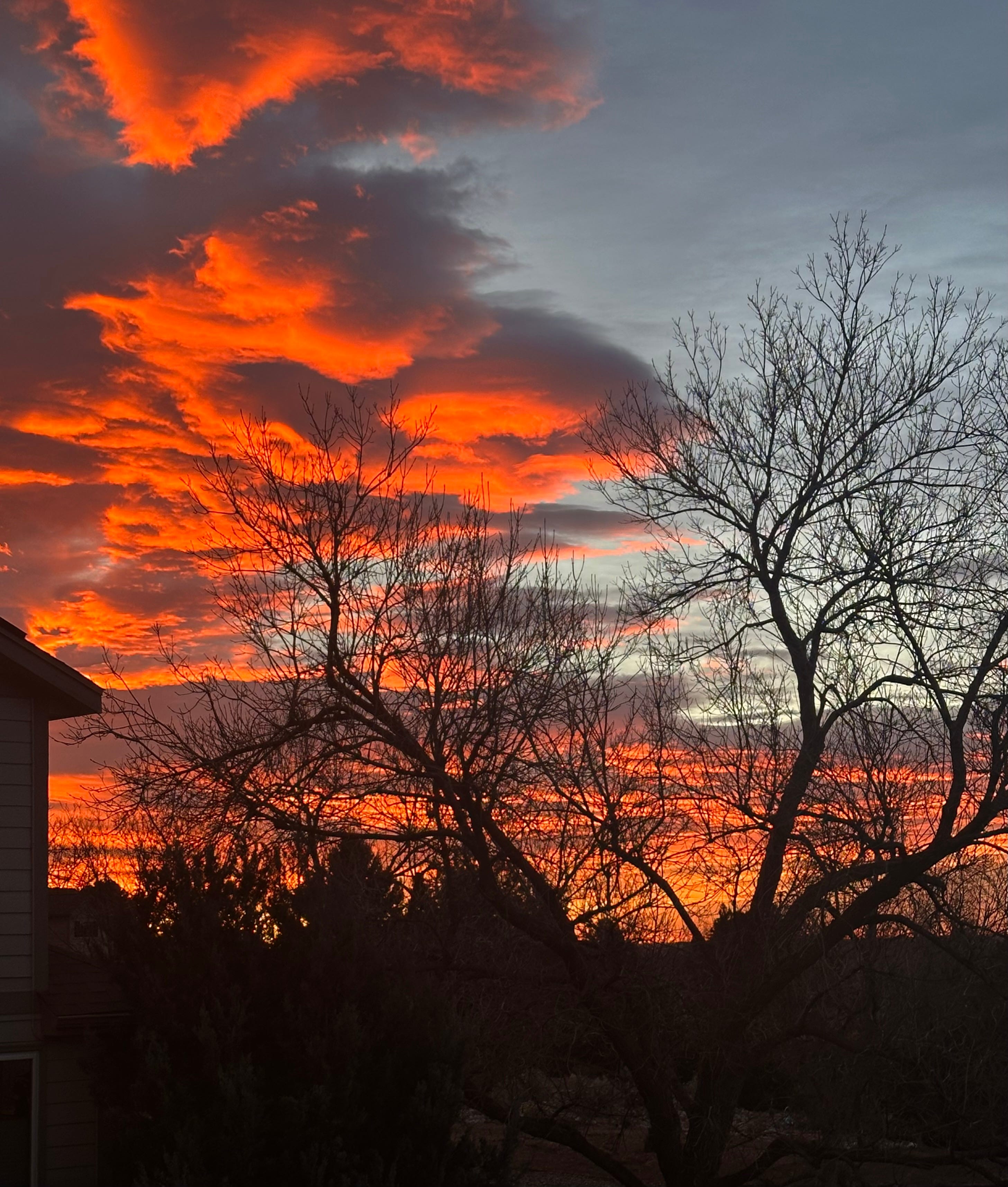
This morning it broke across the sky in fire red, everything burnished. Light reflected bright pink in my dear neighbor’s windows, their house suddenly glowing like a lantern. To the west the foothills turned copper, the bare branches of the trees lit like filaments. It took my breath.
There’s an old saying in the UK: “red sky in the morning, shepherd’s warning; red sky at night, shepherd’s delight”. I grew up hearing this, a rhyme that carried weather wisdom across generations. But it doesn’t quite work here in Colorado. The air is different, thinner, drier, clean. Most days we have that relentless Colorado clarity. Big blue skies where everything feels exposed to the light, almost too seen. When red does arrive, though, I’m pulled back across decades and an ocean, my Mum’s voice, those grey British mornings. But here, it’s both gift and surprise. This morning’s brief flame, not warning but wonder, before the day turned clear and bright.
But whether under grey British skies or Colorado’s blue vault, we all arrive at the same threshold: these short days that make you feel the loss of light, that make you notice when it arrives and grieve when it goes. When darkness holds the greater claim on the day, each hour of light becomes something you can count. Something precious you hold in your hands like water.
I find myself calculating differently now. These are the coyotes’ hours. Dawn’s dimness, dusk’s failing light, when they hunt the trail with the most confidence. Should I wait for full daylight to walk my dog, or venture out when we’re both working the margins? Every task now requires this same weighing, this same negotiation with the light. The day has become a container too small for all I want to fit inside it, and so I’m forced to choose. Not everything will get done. Not everything can be seen or tended or witnessed in these handful of lit hours.
This is what the shortest days teach: discernment. Clarity. The ability to see what’s essential when time itself becomes scarce.
I think about what morning means, what it signifies when it finally arrives after these long December nights. Each dawn is the world beginning again. A chance to remake the day. The earth’s patient rotation delivering me back into light, back into the possibility of motion and work and witness. The sun will rise whether I’m awake to see it or not, whether I’m standing at the window watching or whether I’m still buried under blankets. The earth surely doesn’t need my attention to keep turning.
No, it doesn’t need my attention, but I do. I need these moments of noticing, the way light changes everything it touches. Without them, the days would blur together into a wash of getting through, of survival mode, of waiting for spring. And I don’t want to wait. I want to be here, fully, in these short silent days.
There’s something about scarcity that sharpens appreciation. When I had long summer evenings, I could be generous with my attention. Whole afternoons passed observing the sunset over Mount Meeker as it turned the land amber and gold, knowing there would be another evening tomorrow, and another after that. I took it for granted that there would always be more light, more time, more hours to do what needed doing.
But now, in late December, I can’t take anything for granted. Time feels compressed, the year running faster toward its end. Darkness arrives well before dinner. Morning lingers past breakfast. If I want to see the horses, to feed the bees extra sugar syrup sleeping in their winter cluster, to walk miles with my dog, and observe what this season is teaching, I have to do it now. Not later. Not eventually. Now, while there’s light enough to see.
This urgency isn’t frantic. It’s like narrowing the beam on a flashlight, concentrated, directed. It strips away the inessential and shows me what I truly value: being outside in movement, the sounds and sights of this place, the quality of light on snow, on bare branches.
And I am reminded... we are not separate from this tilting planet, this dance of light and dark. I feel it in my blood, my body’s response to the dimming daylight. I want to sleep longer, move slower, spend more time in stillness and reflection. I can fight it, insist on summer’s pace despite winter’s call, or I can simply acknowledge the truth: this is the time for slowing down, for turning inward, for resting.
Not everything requires light. Some things, deep thinking, integration, the processing of a whole year’s worth of experience, actually need darkness to develop properly. Seeds don’t germinate in the sun; they begin their transformation in dark earth. All year I’ve been in motion, observing, writing, documenting what I see. But observation isn’t the same as understanding. Witnessing isn’t the same as knowing. There’s a difference between collecting experiences and letting them settle into wisdom. I can notice everything, write about every shift in the landscape, pay meticulous attention, but that’s only half the journey. The deeper work, the metabolizing of experience into something that changes how I move through the world, that requires different conditions. It needs space. Stillness. The absence of new input. You can’t integrate while you’re still gathering.
When I stop gathering and start digesting, when all those observations of creek and sky and changing season can finally settle. That’s when the real transformation happens. The darkness these last weeks forces me to stop collecting, and start letting it all work on me from the inside. This isn’t about what I’ve learned anymore, it’s about becoming what I’ve learned.
And I’m not the first to need this darkness. These particular darkest days of the year carry generations of northern winters in them. All those people who wondered if the light would return, who lit candles and built fires, and held festivals at the solstice as a kind of encouragement to the sun: come back, we need you, don’t forget us here in the cold and dark.
There’s an old tradition: bringing fir boughs into the house during the darkest weeks, branches of pine and spruce and evergreen that stay alive when everything else has gone bare. Long before Christmas trees became decoration, people brought these branches inside as something more fundamental – a quiet reminder that not everything dies in the dark. Not a promise that winter would end tomorrow, but proof that life persists in the waiting. The evergreen doesn’t fight the darkness. It evolved to live in them.
I need that reminder. Not to rush past these days toward February’s longer light and the steady march toward spring. But to remember what these short, dark days offer that the bright ones cannot. The chance to stop gathering and finally let a whole year settle into my bones.
The light will return. It always does. But these darkest days aren’t something to simply endure or rush through. This is the season for what I’ve been doing: settling into winter’s depths, letting all I’ve witnessed this year work on me from the inside. The integration, the becoming. And when the light lengthens again and I emerge, I won’t be the same person who began this descent. Like any seed that transforms beneath the surface, I’ll have become something I couldn’t see coming.
—> What moments of natural wonder caught your attention this week? Please share your stories and photos in the comments below. Let’s experience nature’s gifts together.
As always, thank you so much for reading and supporting me.
Love,
Jane
It is interesting the way things seem to make more sense when we slow down in the cold winter months and the dots can almost connect themselves.
Seems like the process has worked well for you, Jane. Makes me smile to know that.
Thank you. A much-needed reminder. For this time of year and this time.